Published: Monday, September 10, 2007
campus tradition
Animal Advocates Target Use Of Mascots
By JERE LONGMAN
The New York Times
BATON ROUGE, La. | Fans who are in town Saturday for Louisiana State's home opener against Virginia Tech can get a glimpse of LSU's latest recruits - football players and a tiger mascot.
LEE CELANO | THE NEW YORK TIMES
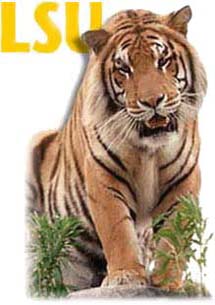
Mike VI, the Louisiana State University Tigers' mascot, rests recently inside his $2.9 million habitat at the university in Baton Rouge, La. LSU has kept live tigers since 1936.
Mike VI, a 2-year-old Bengal-Siberian tiger who is expected to grow to 700 pounds, was acquired in August from an animal-rescue center in Indiana.
The tiger was placed on view Sept. 1 in a $2.9 million, 15,000-square-foot campus habitat equipped with a wading pool, a waterfall, scratching posts, air-conditioned sleeping quarters and around-the-clock care from the LSU School of Veterinary Medicine.
"He probably gets better medical treatment than most of us," Sean O'Keefe, LSU's chancellor, said. "He's one charmed cat."
That is a widely held view here, where football and a live tiger are seen as essential to the character of the state's flagship university. But not everyone agrees. The university and the state are on the skirmish lines of a growing fight waged by animal-rights groups, lawmakers and courts to bar the use of animals as live mascots, for staging fights or even in certain types of sporting equipment. Perhaps never before have animals been so prominent on the sports landscape.
When LSU's previous mascot died in May of kidney failure at age 17, representatives of People for the Ethical Treatment of Animals asked the school not to get another live tiger. PETA argued that tigers need to roam over hundreds of miles, not square feet, and that wild animals become stressed in stadiums filled with tens of thousands of people.
Meanwhile, in June, Louisiana became the 50th state to ban cockfighting. In July, the California Supreme Court effectively prohibited the sale of soccer shoes made from kangaroo hides. And the National Basketball Association continues to experiment with synthetic materials for its basketballs.
Public sensitivity about the treatment of animals has been acutely evident in the past year, with the outpouring of grief after the death of the 2006 Kentucky Derby champion Barbaro and the national outrage aimed at the NFL quarterback Michael Vick after he acknowledged his involvement in dogfighting.
"These are manifestations of increasing concern about well-being and the ethic that if you are going to use animals, there should be a compelling reason," said Wayne Pacelle, the chief executive of the Humane Society of the United States.
changing attitudes
In 1992, Jackie Sherrill, then the football coach at Mississippi State, got off with an apology and a warning after he had a bull castrated to motivate his players for a game against Texas, whose mascot is a longhorn steer named Bevo.
Public attitudes appear to have changed since then. Louisiana state Sen. Arthur J. Lentini of Metairie, a New Orleans suburb, led the effort in Louisiana to ban cockfighting, in which roosters are fitted with spikes for slashing duels. Some Louisiana legislators said that cockfighting was a Cajun tradition and a rural economic lifeline.
Lentini said, "I felt it was very detrimental to the image of this state to be the only remaining state that permitted this activity in which animals are hurt for the amusement and wagering of human beings." The ban takes effect in August 2008.
Last year, the soccer star David Beckham switched from soccer shoes made from kangaroo skin to a synthetic alternative after a campaign by animal-rights groups. In July, the California Supreme Court banned the sale of kangaroo-skin shoes in settling a lawsuit.
Response to the court decision has been mixed. While animal-rights groups celebrated, officials in Australia protested, saying that kangaroos are no longer endangered and need to be culled for proper conservation. A bill that would permit products made from kangaroo hides is pending in the California Legislature.
"Consumers should not be intimidated by the scare tactics of extremists who have a long-term agenda of banning the use of nonendangered animal products," Warren Truss, Australia's trade minister, said in a statement after the court ruling.
The Vick case, too, has come to be viewed by some in a more nuanced way. Vick, who has been suspended by the NFL and faces a possible prison sentence, has been widely criticized. Yet some observers say that Vick has been subjected to greater outrage and punishment than players who have committed violence against people in shootings, incidents of domestic violence or fatal traffic accidents.
The LSU case represents perhaps PETA's most visible attempt to dissuade universities from using live mascots. LSU has kept live tigers since 1936. About three dozen schools keep live mascots. Others have discontinued the practice as being inhumane or too costly for appropriate care.
Southeastern Louisiana University, located east of here in Hammond, once housed a live lion during football season in an arrangement with the Audubon Zoo of New Orleans. The arrangement ended in 1972 when the university, which lacks a veterinary school on campus, realized it could not provide suitable care, Christina Chapple, a Southeastern spokeswoman, said.
"Everybody was excited, then the reality of keeping a live animal on campus set in," Chapple said. "We weren't set up to handle that."
When LSU's previous tiger mascot died, PETA sent a letter to the school saying that large carnivores "suffer extremely" in captivity because they are denied the opportunity to engage in natural behaviors such as running, climbing, hunting, establishing territory and choosing mates. Most universities and all major professional teams use costumed humans, not live animals, as mascots, PETA said.
Last modified: September 10. 2007 5:58AM